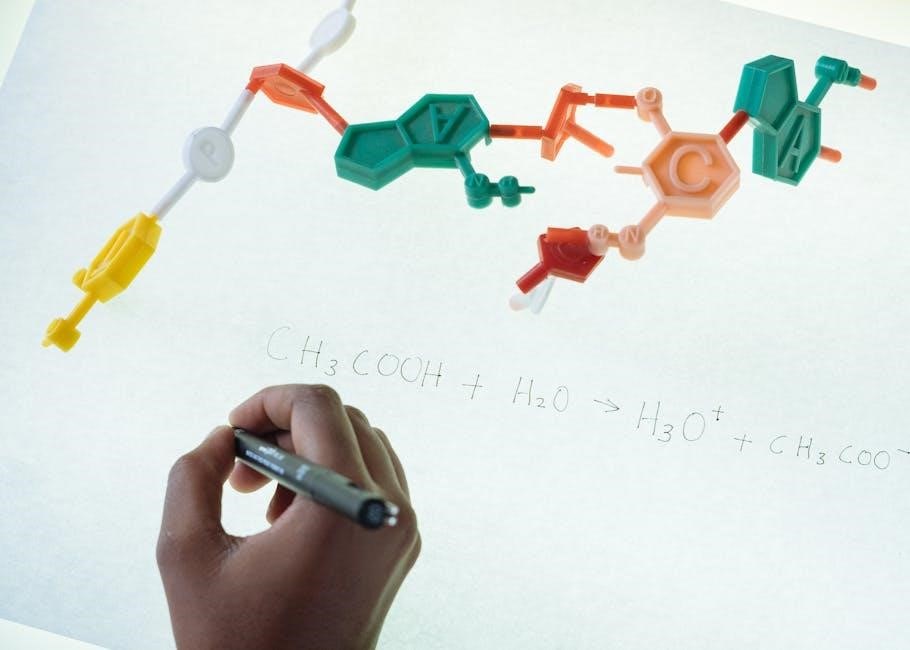
ACS General Chemistry Exam Study Guide Plan

Preparing for the ACS General Chemistry Exam? Utilize the ACS Official Study Guide – a crucial resource bridging coursework and exam needs.
Focus on mastering concepts and problem-solving; aim for 55-60 correct answers out of 70, like top students. Explore resources at acsexamsinstitute.com!
The American Chemical Society (ACS) Chemistry Exam serves as a standardized assessment of general chemistry knowledge for undergraduate students. Often required by colleges with ACS-accredited degree programs, it evaluates a student’s comprehension of fundamental chemical principles. This isn’t merely a classroom final; it’s a benchmark against a national standard, offering percentile rankings to gauge performance relative to peers.
Understanding the exam’s purpose is key to effective preparation. It’s designed to be a comprehensive survey, testing breadth rather than extreme depth in any single area. The exam questions are structured to be efficiently answered – ideally within a minute each – emphasizing both recall and application of concepts.
The ACS exam isn’t solely for accreditation purposes. Many instructors, recognizing its rigor and thoroughness, utilize it as a final exam within their courses, like one professor who found it a suitable challenge for undergraduates. Success often correlates with a score of 55-60 correct answers out of 70, demonstrating a solid grasp of the material. Resources, including official study guides, are readily available through the ACS Exams Institute to aid in your preparation.
What is the ACS?
The American Chemical Society (ACS) is a leading nonprofit scientific organization based in the United States. Founded in 1876, the ACS boasts a rich history dedicated to advancing the broader chemical enterprise and its practitioners. Its core mission revolves around supporting students, educators, and researchers across all facets of chemistry and related fields.
The ACS plays a pivotal role in fostering scientific advancements through publications, conferences, and educational resources. It champions professional development, advocating for sound science policy, and promoting public understanding of chemistry’s impact on everyday life. A significant aspect of its work involves setting standards for undergraduate chemistry education.
This commitment to education manifests in the ACS accreditation of college chemistry programs and, crucially, the development and administration of standardized chemistry exams. These exams, including the General Chemistry Exam, are designed to assess student competency and ensure a consistent level of knowledge across institutions. For further information and study materials, visit acsexamsinstitute.com. The ACS truly serves as a cornerstone of the chemical community.

Exam Format and Structure
The ACS General Chemistry Exam is designed as a comprehensive survey of your understanding of fundamental chemical principles. Typically, the exam consists of around 70 multiple-choice questions, each intended to be answered within approximately one minute. This pacing emphasizes not only knowledge recall but also efficient problem-solving skills.
The questions cover a broad spectrum of general chemistry topics, mirroring a typical year-long introductory course. Expect questions assessing your grasp of atomic structure, stoichiometry, states of matter, thermodynamics, kinetics, equilibrium, acids and bases, and redox reactions. The exam isn’t simply about memorization; it tests your ability to apply concepts to novel scenarios.

While the ACS provides national statistics and percentile rankings, individual colleges may or may not utilize these for assessment. A strong performance, as demonstrated by undergraduates, often involves correctly answering 55-60 questions. Familiarize yourself with the exam instructions, often found on the front cover, as they provide crucial guidance. Resources like the ACS Exams Institute can aid in preparation.
Time Management Strategies
Effective time management is crucial for success on the ACS General Chemistry Exam. Given the exam’s structure – approximately 70 multiple-choice questions – and the recommended pace of one minute per question, a strategic approach is essential. Don’t get bogged down on challenging problems; prioritize answering questions you’re confident about first.
Practice with timed sections mirroring the exam conditions. This builds both speed and stamina. Utilize the initial reading time, while waiting for the exam to begin, to thoroughly review the instructions. This proactive step can prevent wasted time later.
Develop a system for quickly eliminating incorrect answer choices; Even if you’re unsure of the correct answer, narrowing down the options increases your probability of selecting the right one. If a question proves particularly difficult, make an educated guess and move on, flagging it for review if time permits. Remember, completing as many questions as possible is key. Resources from the ACS Exams Institute can help refine your timing.
Key Content Areas: Atomic Structure and Periodicity
A strong foundation in atomic structure and periodicity is vital for the ACS General Chemistry Exam. Expect questions covering electron configuration, orbital diagrams, and the quantum mechanical model. Understand how these concepts relate to an element’s position on the periodic table.
Master periodic trends – atomic radius, ionization energy, electronegativity, and electron affinity – and their explanations based on effective nuclear charge and shielding. Be prepared to predict these trends and apply them to compare different elements.
Know the relationship between electron configurations and chemical properties. Understand how valence electrons determine bonding behavior. Familiarize yourself with the concept of isotopes and average atomic mass calculations. The ACS Official Study Guide will provide targeted practice in these areas.
Practice identifying ions and their electron configurations. Review the rules for assigning oxidation states. A solid grasp of these fundamentals will significantly improve your performance on the exam. Resources at ACS Exams Institute offer focused practice.
Key Content Areas: Stoichiometry and Chemical Reactions
Stoichiometry and chemical reactions form a cornerstone of the ACS General Chemistry Exam. Expect a significant number of questions testing your ability to balance chemical equations, calculate molar masses, and perform stoichiometric calculations.
Master concepts like limiting reactants, percent yield, and reaction stoichiometry. Be proficient in converting between grams, moles, and number of particles. Understand different types of chemical reactions – synthesis, decomposition, single replacement, double replacement, and combustion.
Practice writing balanced net ionic equations, identifying spectator ions, and predicting the products of reactions. Dilution calculations and solution stoichiometry are also frequently tested. The ACS Official Study Guide provides ample practice problems to hone these skills.
Familiarize yourself with the concept of reaction rates and factors affecting them. Understand how to interpret and apply chemical formulas and equations. Utilize resources like ACS Exams Institute for targeted practice and review. A strong understanding of these principles is crucial for success.
Key Content Areas: States of Matter and Solutions
The ACS General Chemistry Exam heavily emphasizes states of matter and solutions. Expect questions covering gas laws (Boyle’s, Charles’s, Ideal Gas Law), kinetic molecular theory, and intermolecular forces. Understand how these principles influence physical properties like boiling point and vapor pressure.
Solution chemistry is equally important. Master concepts like solubility, molarity, molality, and dilution. Be prepared to calculate concentrations and perform solution stoichiometry. Colligative properties – boiling point elevation, freezing point depression, osmotic pressure – are frequently tested.
Phase diagrams and phase transitions are also key areas. Understand how to interpret phase diagrams and predict the state of a substance under different conditions. Know the different types of solutions (solid, liquid, gas) and factors affecting solubility.
The ACS Exams Institute offers valuable practice problems. The ACS Official Study Guide provides a comprehensive review of these concepts. A solid grasp of these principles is vital for achieving a high score on the exam.
Key Content Areas: Thermodynamics and Kinetics
Thermodynamics and kinetics are crucial components of the ACS General Chemistry Exam. Expect questions on enthalpy, entropy, Gibbs free energy, and their relationships. Understand how to calculate these values and predict spontaneity of reactions.
Hess’s Law and standard enthalpies of formation will likely appear. Be prepared to apply these concepts to determine reaction enthalpies. Kinetic principles, including rate laws, reaction mechanisms, and activation energy, are also heavily tested.
Rate constants and the Arrhenius equation are essential to master. Understand how temperature affects reaction rates and how catalysts function. Be able to determine the order of a reaction from experimental data.

The ACS Exams Institute provides practice problems to solidify your understanding. The ACS Official Study Guide offers a detailed review of these concepts. A strong foundation in thermodynamics and kinetics is vital for success on the exam. Practice applying these principles to various reaction scenarios.
Key Content Areas: Equilibrium
Chemical equilibrium is a cornerstone of general chemistry and a significant portion of the ACS exam. Expect questions covering equilibrium constants (Kc, Kp) and their applications. Understanding Le Chatelier’s principle is paramount – predict how changes in concentration, pressure, and temperature affect equilibrium position.
Be proficient in setting up ICE tables (Initial, Change, Equilibrium) to calculate equilibrium concentrations. Calculations involving Ka, Kb, and Kw for acids and bases are common. Solubility equilibria and the solubility product (Ksp) will also be tested.
Understand the relationship between Gibbs free energy and the equilibrium constant (ΔG° = -RTlnK). Be prepared to apply these concepts to various reaction scenarios, including those involving gases and solutions.
The ACS Exams Institute offers targeted practice. The ACS Official Study Guide provides comprehensive coverage. Mastering equilibrium concepts is crucial for achieving a high score. Focus on applying these principles to both qualitative and quantitative problems.
Key Content Areas: Acids and Bases
Acids and bases form a substantial part of the ACS General Chemistry Exam. Expect questions on acid-base definitions (Arrhenius, Bronsted-Lowry, Lewis) and pH calculations. Strong acids and bases will be heavily emphasized, alongside weak acid/base equilibria.
Master calculating pH, pOH, [H+], and [OH–] for various solutions. Understand acid dissociation constants (Ka) and base dissociation constants (Kb), and their relationship to acid/base strength. Buffers are critical – know how they resist pH changes and how to calculate their capacity.
Titration curves will likely appear; be able to interpret them and identify equivalence points. Polyprotic acids and their stepwise dissociation will also be tested. Hydrolysis of salts and its effect on pH is another important concept.
The ACS Exams Institute provides focused practice problems. The ACS Official Study Guide offers detailed explanations. A solid grasp of acid-base chemistry is essential for success. Practice applying these concepts to diverse scenarios;
Key Content Areas: Redox Reactions and Electrochemistry

Redox reactions and electrochemistry are frequently tested on the ACS General Chemistry Exam. A firm understanding of oxidation states is paramount; practice assigning them accurately. Balancing redox equations in both acidic and basic conditions is crucial – master both the half-reaction and oxidation number methods.
Electrochemical cells, including galvanic (voltaic) and electrolytic cells, will be a focus. Know how to calculate cell potential (Eocell) using standard reduction potentials. Understand the Nernst equation and its application to non-standard conditions.
Electrolysis and Faraday’s laws are important concepts. Be prepared to calculate the amount of substance produced or consumed during electrolysis. Corrosion and its prevention may also be included.
The ACS Exams Institute offers targeted practice. The ACS Official Study Guide provides detailed explanations and worked examples. Practice identifying oxidizing and reducing agents, and applying these principles to real-world scenarios for optimal preparation.
Utilizing the ACS Official Study Guide
The ACS General Chemistry Official Study Guide is an indispensable tool for exam preparation. It’s designed to align with the exam’s content and format, offering a comprehensive review of key concepts. Don’t simply read it; actively engage with the material.
Focus on the practice questions. These are designed to mimic the style and difficulty of the actual ACS exam. Analyze your mistakes carefully – understand why you got an answer wrong, not just what the correct answer is.
Pay attention to the detailed explanations provided for each question. These explanations often reveal common misconceptions and provide valuable insights into the underlying principles. Utilize the guide’s organization to identify your weak areas and concentrate your study efforts accordingly.
The ACS Exams Institute complements the official guide with additional resources. Remember, the guide is a roadmap; consistent effort and active learning are essential for success.
Practice Exams and Resources
Beyond the ACS Official Study Guide, supplementing with diverse practice materials is crucial. Numerous online platforms and textbooks offer general chemistry practice questions, though ensure they align with the ACS exam’s scope and difficulty. The ACS Exams Institute provides valuable resources, including additional practice tests.
Seek out full-length practice exams that simulate the actual exam conditions – time constraints, question types, and overall length. This builds stamina and helps refine your time management skills. Don’t just take the exams; meticulously review your performance.
Utilize past ACS exams if available (though access may be limited). These provide the most authentic practice experience. Explore university chemistry departments’ websites; some may offer practice materials or links to helpful resources.
Remember, consistent practice is key. Regularly testing your knowledge reinforces concepts and identifies areas needing further study. Combine varied resources for a well-rounded preparation strategy, maximizing your chances of success on the ACS exam.
Analyzing Your Performance on Practice Exams
Simply taking practice exams isn’t enough; thorough analysis is paramount. Begin by identifying patterns in your errors. Are you consistently struggling with specific content areas – stoichiometry, thermodynamics, or equilibrium? Pinpointing these weaknesses allows for focused review.
Categorize your mistakes: conceptual misunderstandings, calculation errors, or careless mistakes. Conceptual errors require revisiting the underlying principles, while calculation errors demand practice and attention to detail. Careless mistakes highlight the need for improved focus during the exam.
Review each incorrect answer meticulously. Understand why you made the mistake, not just what the correct answer is. Work through the problem again, step-by-step, to solidify your understanding.
Track your progress over time. Note your scores on each practice exam and monitor improvements in your weak areas. This provides valuable insight into your preparation and helps you adjust your study plan accordingly. Utilize percentile rankings, if available, to gauge your standing.
Final Exam Day Tips and Strategies
Prior to the exam, ensure you’ve read all instructions thoroughly – often found on the exam cover, these are for both proctors and students. Familiarize yourself with the format; the ACS exam is designed for relatively quick answers, aiming for under a minute per question.
During the exam, manage your time effectively. Don’t get bogged down on difficult questions; skip them and return later. A strategic approach maximizes your attempt rate. Remember, partial credit may be awarded, so attempt every question, even if unsure.
Read each question carefully, paying attention to units and significant figures. Show your work clearly, as this can earn you partial credit. Double-check your calculations and answers before moving on.
Stay calm and focused. If you feel overwhelmed, take a deep breath and refocus. Trust in your preparation and remember the strategies you’ve practiced. A positive mindset can significantly impact your performance.
Remember to bring all allowed materials, like calculators and pencils!